

Why Succession Planning Matters for Family Businesses
For many family business owners, the business represents more than an income. It’s the result of years of hard work and dedication, and often an important part of the family’s identity. So, deciding what happens next can feel like a big decision.
Unlike other businesses, family businesses need to balance commercial decisions with personal relationships. Conversations about who will take over and how ownership will be shared can involve parents, children, siblings and other family members.
That’s why succession planning is about more than simply choosing a successor. A clear plan provides certainty for the family, protects the business’s future, and gives the next generation time to develop the skills and confidence they need. Planning ahead can also give employees, customers and suppliers confidence in the future.
Unfortunately, many families wait until they’re forced to make decisions, adding unnecessary pressure to an already emotional process.
The Risks of Not Having a Succession Plan
While it can be tempting to put off succession planning, especially when retirement feels a long way off, not having a clear plan can leave a family business exposed to unnecessary risk.
One of the biggest concerns is family conflict. Family members may have different ideas about who should lead or how ownership should be divided. Without clear conversations and expectations, these differences can put pressure on relationships.
There can also be business disruption. Uncertainty around the transition can affect employees, customers and suppliers, particularly if they’re unsure what the future holds.
There are also financial considerations. A poorly planned handover can affect the value of the business and may lead to unexpected tax or ownership issues.
What Should a Family Business Succession Plan Include?
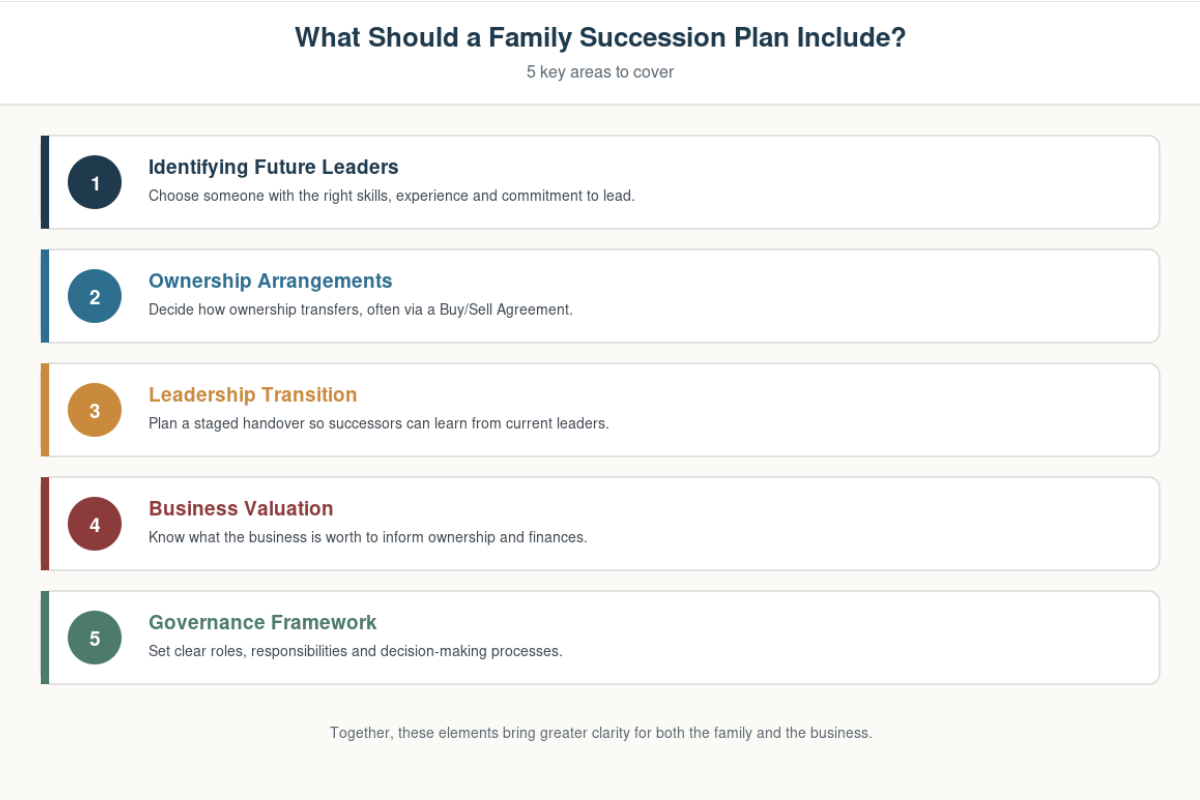
While there’s no one-size-fits-all approach, a well-thought-out succession plan usually covers several key areas:
Identifying Future Leaders
Choosing the next leader means considering who has the right skills, experience and commitment to take on the role. Giving potential successors time to learn and build confidence can make the transition much smoother.
Ownership Arrangements
It’s important to consider how ownership will be transferred, particularly when some family members work in the business, and others don’t. A clear plan can help everyone understand how ownership and finances will be managed. This may include a Buy/Sell Agreement to help facilitate the transfer of ownership if an unexpected event occurs.
Leadership Transition
A successful handover rarely happens overnight. A staged transition gives the next generation time to learn from current leaders and develop a strong understanding of the business.
Business Valuation
Knowing what the business is worth can help inform ownership transfers and financial arrangements, giving everyone a clearer picture of what’s ahead.
Governance Framework
Clear roles, responsibilities and decision-making processes can help keep everyone on the same page. Depending on the business, this may include formal agreements or family governance arrangements.
Together, these elements provide greater clarity and help reduce uncertainty for both the family and the business
Common Succession Planning Challenges for Families
Succession planning can be an exciting time for families, but it can also bring some difficult conversations. You’re not just planning for the future of the business; you’re also navigating family relationships, personal goals and expectations.
Retirement and letting go can be particularly challenging for someone who has spent decades building a business. Deciding who will take over and when the transition should happen can be an emotional process.
Different expectations can also create tension, with parents, children and other family members having different ideas about the future.
Then there’s fairness. Treating everyone equally doesn’t always mean giving everyone the same share. The right approach should balance family relationships with what makes sense for the long-term success of the business.
The next generation also needs time to prepare through mentoring, leadership development and hands-on experience. Working with an adviser on Business Succession Planning can help families navigate these decisions and create a clear path forward.
When Should Family Business Succession Planning Begin?
Like most things in life: the earlier you start, the better. Ideally, family businesses should consider succession planning several years before the current owner decides to step away.
Starting early gives the next generation the time and resources needed to take on responsibility in a gradual, less-demanding way. It also allows the family to work through key decisions without feeling rushed. Most importantly, starting early allows time for the family to adjust if unexpected issues arise.
Succession planning isn’t just about preparing for retirement. Things can change without warning, whether through illness, injury or the loss of an owner. Having a plan in place, including Buy/Sell arrangements, means everyone has a clearer understanding of what happens to the business and ownership if the unexpected arises. It’s also not something you can set and forget. As the business grows and circumstances change, the plan should be reviewed to make sure it still works for everyone involved.
Protecting the Future of Your Family Business
Passing a family business to the next generation involves more than deciding who will take over. It’s about protecting the people, relationships and legacy behind the business. A solid succession plan provides clarity and confidence while helping the business navigate change. It also allows the transition to happen gradually, reducing unnecessary stress.
At Panorama Financial Services, we work closely with family businesses to put succession plans in place that consider both the future they’re working towards and the unexpected. From planning for retirement and the next generation to Buy/Sell arrangements that help protect the business if circumstances suddenly change, the right strategy can provide clarity for everyone involved and help protect the future of the business.
Frequently asked questions
Explore the answers to some common questions about how business succession planning.
The earlier, the better. Ideally, planning should begin several years before an owner retires or steps away, giving everyone time to prepare, have important conversations and adjust the plan if circumstances change.
Without a clear plan, important decisions may be made under pressure. This can lead to family disagreements, uncertainty around leadership and ownership, business disruption and financial challenges.
This depends on the family and business, but usually includes the current owner and potential successors. Other family members, business partners and professional advisers may also play an important role.


Calendar
We’re here to help you protect what matters most.
Whether you’re planning for your family, your future, or your business, our team listens, simplifies, and guides you every step of the way.
Reach out and let’s build your peace of mind together.